In the world of the internet, writing good emails is one of the most important skills you can acquire. Ten or twenty years ago it was almost impossible for someone like me to reach someone in Silicon Valley. Today it is possible. You can reach anyone, in any corner of the earth. A good email can change your life.
How to email anyone and get a response.
This is how I got responses from people like Mark Cuban and raised millions of dollars from Twitter founder Biz Stone, Balaji Srinivasan, and many others. I have had billionaires reply to my cold emails and even invest in my company. I credit a large part of my professional success to writing good emails.
This chapter is a collection of the approaches, sample emails, and tactics I use. Good email is not just clean writing. A lot of other things go into it, and we will go through all of them.
The first step in doing anything well is to actually care about it. There are no shortcuts here. If you are cold emailing someone, do your research. Do not copy and paste the same email to hundreds of people, tell yourself you cold emailed everyone, and then wonder why nobody replied. That is not how it works.
Before getting started
Everyone wants to connect with interesting people, and the way people connect is through stories. Live an interesting life and live to tell the tale. Working hard and smart for a long time is a very good way to build up a story worth telling. Do not put money at the center of every decision. Spend some time early in your life working on interesting things, the harder the better, and always do more than what is asked of you. Take ownership for things no matter how hard they are. Everyone’s life is different and only you can tell your story, so remember that the story of your life is the starting point. Think of it like connecting dots to unlock new stages. The more you do, the more unlocks and opens up for you to explore.
Research, how to get started
Now let us get into the actual process. There is no one size fits all approach to email. You have to do your own research every single time. Cold email is not copy pasting one message to everyone, or blasting a mass email out. It is an art and a skill, but it is one you can learn if you put in the time.
First and foremost is research. Know who you are emailing. Know what they like, what they care about, whether they are a fit for you, whether there is something you can help them with, and whether there is something they are particularly qualified to help you with.
The way I research a person is simple. I start with a Google search and read up on them, some news, some blogs, things they have written. Then I go to LinkedIn, find out more about their work, look at their company, the size of it, the products and projects they are working on. Then I come back to their profile and check their past experience, the companies they have worked at, the projects they have done, and what they seem to be interested in. By this point I have a good idea of who I am about to email, at least how they present themselves online. Try to pick up a few things you can use in your email. A project they worked on, something tied to your business, a personal interest. After a while this becomes automatic as you read profiles.
Once you have a good sense of how to approach the person, the next step is getting their email address. There are many tools for this. Here are the ones I use.
- RocketReach, https://rocketreach.co/, gives you verified emails. You can search by name or by LinkedIn profile and get both personal and work addresses.
- Clearbit Connect, get the extension here, lets you search by domain and find every email under it, right inside Gmail.
- Hunter, https://hunter.io/, finds emails, manages campaigns, and cleans up your lists. If you collect a big list of emails it is a good idea to clean it for deliverability. If you send a lot of undeliverable email, your provider can flag you and your emails start landing in spam.
- Norbert, https://www.voilanorbert.com/, finds and cleans up emails for deliverability. It can also enrich a list with publicly available data like LinkedIn, Facebook, and Twitter profiles connected to an address.
Subject lines, how to write a good one
Once you have figured out who to email and gathered some background, the next task is the email itself, starting with the subject line.
The examples below are for personal emails, not marketing emails. Marketing emails use a different set of psychological techniques to get people to open and respond. Here are some effective subject lines I have used in the past.
Most busy people glance at your email for one or two seconds before deciding to delete it or read more. If you write in marketing speak, they are very likely to skip it or trash it. If you get past those first couple of seconds, they will read on for another five to ten seconds. We will get to how to put the content together shortly. For now, here are some bad subject lines so you know what to avoid.
Rule of thumb
Short, pleasant, to the point.
Real examples from my own emails
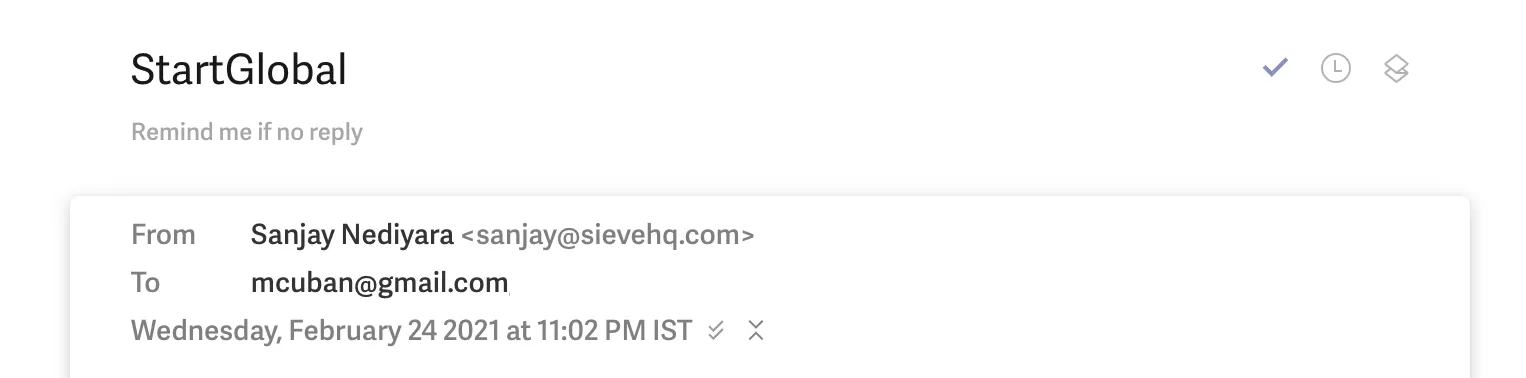
My email to Mark Cuban that got a response.

My email to Michael Seibel, President and CEO of YCombinator, that got a response.
Content, everything about the body of the email
This is the most important part of the chapter. Content is everything. It should be short, crisp, and to the point. I read through the content a few times before sending, and each time I strip out anything that is not pulling its weight. I use a three-part approach to the body of every email.
- Introduction
- Brief
- Ask
The introduction is where you introduce yourself or open with something you found in your research. It is the conversation opener. Lead with something interesting, remind them how you met, mention a mutual interest, or say plainly why you are writing. If there is one rule of email, it is brevity. Write the shortest email possible, then cut it down again. Remove every unnecessary word. Avoid marketing speak, because a busy or successful person can smell it a mile away and hates it. In a cold email you are working with less than ten seconds of attention, split into three. The first two or three seconds, they read your opening lines. Then they decide whether to read the rest. Then they decide whether to reply. The introduction is the part that earns you the next sentence.
The brief is where you describe your business or your question. Again, no marketing speak. Say clearly what your product or business is and why they might want to help, how you can add value to them, or how they can add value to you. This is the crux of the email, and your goal is to convey the idea in as few words as possible.
The last part is the ask. What do you actually want from them? If you end with “I want to build a million dollar business and I need your help,” there is nothing they can do over email. People respond when the ask is something they can decide on right away. Something small and immediate. “Can we grab a coffee to pick your brain” is almost always a no. “Would you like to take a closer look? I can send over a deck” is far more likely to be a yes, because there is no pressure and they can ask for more if they want it. Keep your closing concise and respectful, and stay professional all the way through.
Punctuation, more important than you think
This seems like a small thing, but the mistakes are far more common than you would expect, and they matter more than you think. Here are the ones to avoid.
- Copy pasting content from another place with its formatting.
- USING ALL CAPS TO WRITE A SENTENCE.
- Spelling mistakes in names.
- Not using proper formatting.
- Mixing formats in a single email, with multiple fonts and sizes.
Sending, just send them out
Just do it. Whenever you are in doubt, send the email. It does not matter if you get no response, or get ignored, or do not get what you hoped for. Always take your chances. You only have to be right a few times in life.
Followup, your followup game decides your fate
People are busy, lazy, distracted, and dealing with their own lives. If you do not get a reply, it could mean a hundred things. Want to know which one? Follow up and ask. If you use a client like Superhuman you can set reminders to follow up after a set number of days. The schedule I personally use is this.
- First followup after 3 days.
- Second followup after 7 days.
- Third followup after 14 days.
- Then once a month or once a quarter, depending on the person. For a high value investor or client, a quarterly or even annual update on your progress can be what eventually closes them.
- Respect their time. If they signal they are not interested, leave them alone.
Iterate, practice makes you better
No one can teach you everything. Iterate based on your own experience. Try new copy, test different content, and customize heavily for each person.
Etiquette, the dos and don’ts
The dos.
- Write crisp, short emails.
- Respond quickly, in under 24 hours and ideally under 12.
The don’ts.
- Do not overdo your followups to the point where the other person blocks you.
- Do not leave people hanging. Always acknowledge. If you get an email, reply as soon as you can. Most importantly, let them know you got it and are working on it.
Management, how to step up your email game
There are different approaches to email. Some are traditional and sit on top of what you already use, like Gmail and Google Workspace. Others are all in one experiences, like Superhuman. These are the tools I reach for.
- Superhuman, https://superhuman.com/, a fast unified email experience with built in followup reminders.
- Clearbit Connect, get the extension, finds verified emails by domain inside Gmail.
- Mailtrack, https://mailtrack.io/, tells you when your emails get opened.
- GMass, https://www.gmass.co/, runs mail merges and campaigns from within Gmail.
- RocketReach, https://rocketreach.co/, finds verified personal and work emails by name or LinkedIn.
- Hunter, https://hunter.io/, finds and verifies emails and cleans your lists for deliverability.
Sample Emails, examples you can copy
The two screenshots above are real emails I sent. The templates below follow the Introduction, Brief, Ask structure from earlier in this chapter. Tap Copy on any card, then swap in your own research and details. Keep them short, and when you think they are short enough, cut them down once more.
Cold email, leading with research
Hi [Name],
I read [your essay / saw your talk] on [specific topic], and [one genuine, specific line that proves you actually did the research, not flattery].
I'm building [Company]. We help [who] do [what], and [the one number or fact that shows it is working]. I'm reaching out because [a specific reason tied to them].
Would you be open to taking a look? I can send a one-pager, no pressure either way.
Thanks,
[Your name]
Cold email, investor, via a mutual connection
Hi [Name],
[Mutual connection] mentioned you back early founders working on [space], so I wanted to reach out directly.
[Company] helps [who] do [what]. We're at [the metric that proves traction, like revenue, users, or growth rate], growing [x]% a month. We're raising a [round] to [the specific milestone it gets us to].
Could I send over a short deck? Happy to answer anything right here on email.
Best,
[Your name]
Follow-up, same thread, a few days later
Hi [Name],
Quick nudge in case this slipped. I know you're busy.
Since I last wrote, [one line of new progress: a launch, a milestone, a new customer]. Still glad to send the one-pager whenever it's useful.
Thanks,
[Your name]
Further Reading
Some of the best things written on cold email and reaching people. Worth your time.